
Trash Talk: Giving Food Scraps a Second Life
October 24, 2026
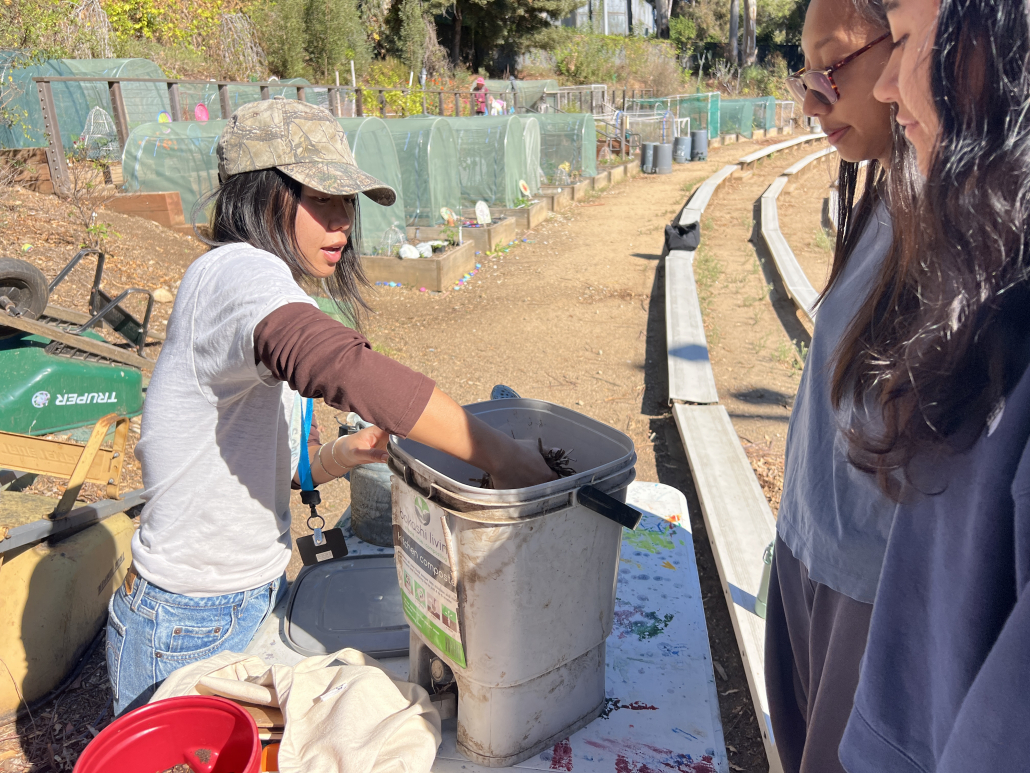
One person’s trash is another person’s treasure, and in the garden, that treasure might just be compost! Through composting, everyday waste gets a second life. On Saturday, October 24th, Master Gardener Melody Hwang covered the basics of composting at the jane b semel HCI Community Garden’s second workshop of the Fall quarter. From fallen leaves to food scraps, we explored how everyday organic materials transform into compost and why compost might just be the magical ingredient your soil is missing.
We learned about the two essentials of composting: greens and browns. Browns, such as fallen leaves, branches, and cardboard, provide carbon, which serves as an energy source for the microorganisms responsible for breaking down organic matter. Greens, on the other hand, supply nitrogen, helping these microbes grow and reproduce. Together, carbon and nitrogen create the ideal conditions for decomposition, transforming food waste into nutrient-rich organic matter that replenishes the soil. Hwang made the process easy to visualize by comparing a compost bin to lasagna. Start with a base layer of browns, alternate with greens, and finish with a top layer of browns to help prevent odors.
Hwang also shared her favorite composting system, vermicomposting, which uses worms to break down organic waste and produce nutrient-rich castings. As we learned more about the process, we wondered whether vermicomposting would produce an unpleasant smell. After all, the idea of decomposing food and worm castings might sound a little unpleasant! Hwang assured our workshop attendees that a properly maintained composting system should not produce any odor. We are happy to report from our firsthand experience that we agree! The worm castings should have a moist texture and as expected, an earthy scent.
Beyond learning how compost works, we also explored how composting practices can differ depending on the system being used. This led to a great question from one of our participants: “Why is dairy accepted in the compost bins on campus when it’s usually not recommended for home composting?” The answer comes down to equipment: Campus composting systems have specialized equipment that can generate and maintain the high temperatures needed to break down a wider range of organic materials, including dairy products.
From learning how to layer our compost, to getting up close with worm castings, we left the workshop with a newfound appreciation for things that help our garden thrive. We had such a great time learning from Master Gardener Hwang, sharing questions, and getting our hands dirty along the way. It was especially meaningful to learn from someone passionate about sharing her gardening expertise. With plenty of knowledge to take back home, this workshop has earned a special place on our list of favorite workshops this quarter!
Interested in hearing about our future events? Follow us on Instagram @hcigardens and subscribe to our biquarterly newsletter to stay in the know about our workshops, garden drop-in hours, and more.
Author Bios:
Jeorgette Urbano is a Garden Coordinator at the jane b semel Healthy Campus Initiatives Community Garden. She is a third-year undergraduate student majoring in Political Science and History. In her spare time, she enjoys reading and actively engaging with her local community.
Ashley Te is a Garden Coordinator with the jane b semel Healthy Campus Initiatives Community Garden and a 4th year Art and Ecology, Behavior & Evolution double major. In her spare time, she enjoys rollerskating and painting.