
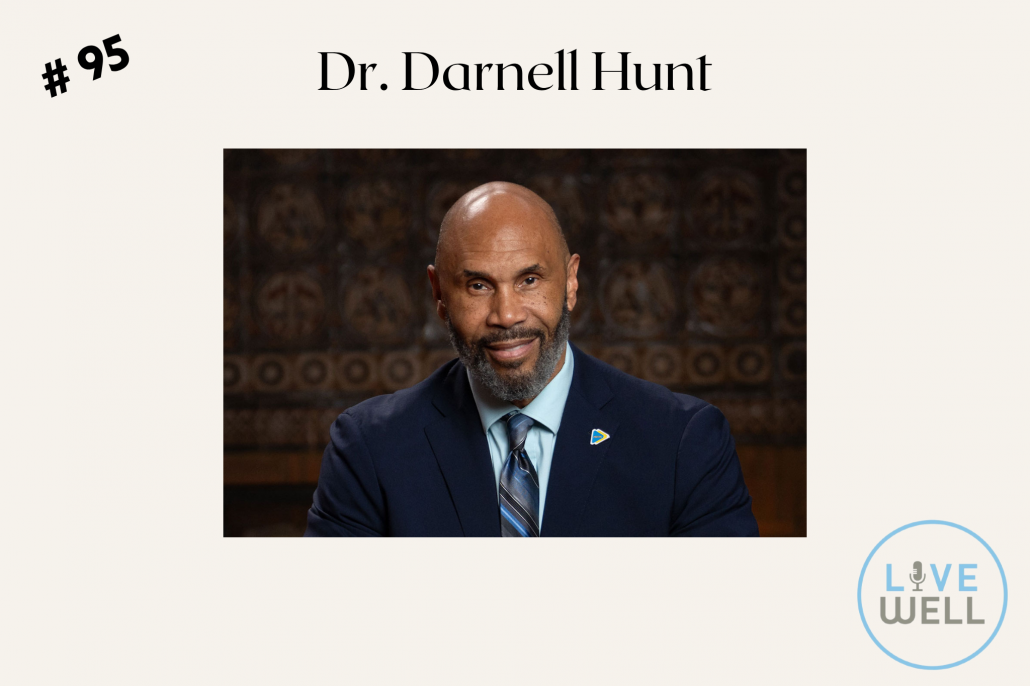
Transcript of Podcast 95: Whose Stories are Told? Whose are Missing? The Power of Representation with Dr. Darnell Hunt
June 24, 2026
Dr. Wendelin Slusser: [00:00:00] Welcome to the UCLA Live Well podcast. Our guest today is UCLA’s Executive Vice Chancellor and Provost Darnell Hunt. With three decades on campus, Dr. Hunt has an impressive and impactful history as a Bruin from a 16 year stint transforming the Bunch Center into a national leader for African American studies.
To his involvement in the founding of the Barbara Streisand Center For the Study of Women these days, most of us on campus know him as our EVCP, the leader guiding UCLA through its most recent five year strategic plan. Proud UCLA alumnus himself, Darnell famously developed the UCLA Hollywood Diversity Report, a landmark project that uses a scientific lens to measure representation in the entertainment industry.
From his early days at NBC in Washington DC to his transformative years as our Dean of social sciences, he has focused on [00:01:00] how our ways of seeing impact the way we live.
Darnell, your work in Hollywood and your leadership here at UCLA are so beautifully intertwined. I’m eager to dive into how representation and the stories we tell. Can help us take agency in writing a new, healthier chapter for us all. Welcome to the show.
EVCP Darnell Hunt: Well really happy to be here today.
Dr. Slusser: Cool, thank you.
So let’s dive in to our conversation today, and rather than beginning at the start of your career, I’d like to jump ahead to 2014 when you launched the Hollywood Diversity Report. What exactly is in this report?
EVCP Hunt: Yeah, so, um, so I’m a sociologist. I study race and media and, you know, my earliest work was on news and the impact that news plays in shaping the way people see reality.
Somewhere along the way, I made a shift to then say, well, let’s talk about fictional media content. And of [00:02:00] course, being in Los Angeles, Hollywood became a focus. Um, I did some work with the US Commission on Civil Rights. Following the 1992 LA uprisings. Um, typically when there are major disturbances, urban disturbances, you know, the, um, civil Rights Commission goes to the city, the region where they had the disturbance to try to understand what the underlying tensions were that led to the disturbances.
So they came to LA in 1993. I think it was early 1993 to kind of figure out sort of what was happening here. As it turns out, I was a graduate student at UCLA at the time, uh, in sociology. My dissertation was on the, uh, Rodney King beating and everything that happened after that. Specifically news coverage of, um, the, um, the urban uprising that happened in Los Angeles, and the ways in which news coverage.
Shaped the way people perceived what was happening. So I had reached out to the, uh, LA Commission on Civil Rights, the LA um, um, human Rights, um, commission, human Relations Commission that was doing work with, [00:03:00] with the US Commission on Civil Rights. And they had data from a local news station that they determined had the most objective coverage of the uprisings.
And I wanted to. Look at that footage and reference it in my dissertation. Just so happens I was there at the same time as the US Commission of Civil Rights Representative was there ’cause they were looking for on the ground support for their investigation in la. And the LA Human Relations Commission said, oh, we have this graduate student from UCLA who’s doing a dissertation on the uprisings.
Why don’t you talk to him? Long story short, I ended up being deputized by the US Commission of Civil Rights. I flew back to Washington, um, was sort of brought on board, and I accompanied their attorneys all over LA as they were interviewing people to testify during the hearing. They had la the public hearing.
One of the things they wanted to do since they were in LA was to visit Hollywood to see what impact media images and storytelling may have had on why people participated or didn’t participate. And because I was working on media and race, they thought I’d be the perfect [00:04:00] chaperone to take them around.
So that was really my introduction to Hollywood and, and, and the ways in which inclusion or lack thereof impact storytelling. And so my own scholarly research kind of followed. So again, fast forward to 2014. This is a decade later. I’m at UCLA, I am the director of the Ralph J Bunch Center for African American Studies.
I’d already been doing some smaller studies on Hollywood diversity and you know, we decided to take a look at what was out there. There wasn’t a lot, a lot of what we knew about diversity in Hollywood was anecdotal there. There weren’t comprehensive data-driven studies. So I took, uh, my co-author and I, we visited pretty much every major studio, TV network, and we just started asking them if there was gonna be an academic study on Hollywood diversity, what would you wanna see included?
Because we don’t wanna just do a report to do a report. We were attempting to do a report that would change behavior in the industry. So our audience really was industry decision makers, our primary audience. And what we kept hearing over and over again was [00:05:00] that if you can tie Hollywood diversity to the bottom line, the industry’s gonna care because you know, the industry cares about profit.
I mean, that’s the main thing. And if you can do good by doing well, then that’s a good thing. But you have to show that you’re doing well before they’re gonna really be interested in doing good. So we essentially designed a study. To relate onscreen representation of people of color and women to, uh, ratings in television and box office and film.
And that was the birth of the Hollywood Diversity Report, uh, in 2014 and now 2026 we’re, I guess 12 years into it. Um, we, we still do the report. Initially it was one report a year. That looked at TV and film combined, but the report grew to the size where we ended up releasing three reports a year. One looking at sort of television, uh, streaming films and then Hollywood theatrical releases because each of those types of releases were, were slightly different in terms of the market impact.
And we wanted to really dive deep into the numbers to understand what was happening. And by the way, we have a new [00:06:00] report coming out the second week of March of 2026. Oh, wow. So I just, I just, I just edited the draft, uh, the other day. Oh, that’s exciting. So you’re still at it even though you’re executive.
Well, I, I’ve taken a step back. I mean, I, so my co-author is now the lead, uh, one of my PhD students in sociology who graduated last year is now the, the second author. I’m, I think I’m fourth author on the report now. Well, that’s still great. It shows what, how important that report is for you and also for our whole city and our country.
Really, when you find data that you can drive change, that’s phenomenal. And I wanna. Step back. There was an interview of you with you around this subject and you mentioned one of your favorite sitcoms when you were growing up. I mean, this is something that you’ve been interested in, it sounds like, for a long, much longer than even your academic career.
Yeah. I mean, I think you’re talking about the Jeffersons, of course. When I watched The Jeffersons growing up. I didn’t think I’d be an academic a, in that I’d be studying [00:07:00] media. But nonetheless, I mean, it sort of, um, when I reflect back on it, it was, I think an informative TV show because it was one of the few shows that featured an African American family, in fact, an aff fluent African American family.
It was a, it was a sitcom, so it was sort of on the ridiculous side, but nonetheless, it was an image. It was, it was storytelling that we didn’t typically see back then. I guess one funny anecdote about that is that, you know, this was in Washington dc, which is where I grew up. I moved to LA and I ended up moving into the home of one of the lead actors in the show.
Dr. Slusser: Oh my gosh.
EVCP Hunt: Roxy Roker, and for those who don’t know who Roxy Roker is, she’s Lenny Kravitz’s mom.
Dr. Slusser: Whoa.
EVCP Hunt: So I was walking my dog one day when we were living in the house and this car pulls up real slow and this guy sticks his head out of the window and he goes, do you live there? And I said, yeah. He goes, I used to live there.
And I said, yeah, I know. Because I knew who he was. Uh, it was, it was only Kravitz.
Dr. Slusser: Amazing.
EVCP Hunt: And he basically came and hung out with us for like a couple of hours, like showing us around the house. This is where I hung out with my friends. Oh, this is where my [00:08:00] mom was the whole bit. Yeah.
Dr. Slusser: Wow. It must have changed that your experience of the house.
EVCP Hunt: Yeah. Yeah.
Dr. Slusser: Well, you know, just shows how reflecting on your experiences, even when you’re young, can really drive you to a, a profession of sorts. One of the reports, most compelling findings that you mention is diversity cells. And what does that mean for the future of industry? This, uh, report that you’ve been putting out for since 2014?
EVCP Hunt: Yeah, so one of the things that we’ve tracked over the years and, and, and I should say that one of the. Features of the report that was novel and no one else has done this as far as we know, there’s nothing else like this, is that we have a pretty rigid methodology that we follow year from year. So we can now, you know, have longitudinal data that’s pretty reliable, so powerful in terms of showing the changes over time from year to year.
So we can actually say, you know, it’s better this year than it was two years ago across a range of measures. Well, one of the things we also look at is, is the, um, changing demographics of the US population. [00:09:00] And everyone knows the US is becoming more diverse. In fact, we’re gonna be majority minority in a, in a what, I guess a decade and a half.
I lose track of where we are, but mm-hmm. But, but yeah, we’re getting to that point. So this study started 12 years ago. We’re a lot more diverse now as a nation than we were when we started to study. So we are able to see over time. How the populations become more diverse and how that’s sort of impacted ratings in TV and box office.
And one of the things we found in our initial report in 2014 is that films and TV shows that looked more like the American population at that time in terms of diversity. Tended all things equal to do better, to have higher ratings and higher box office. Why? Because people wanna see stories and characters that resonate with them.
It’s not that they don’t wanna see other people, they just wanna see themselves included. So the shows that were more diverse had something for everybody, and lo and behold, the audiences were larger, IE more money. So our point to Hollywood was, if you wanna make more money, which is what you say you wanna do, why don’t you produce more [00:10:00] diverse.
Programming that not just includes more people of diversity, women and people of color on the screen, but also stories that feature them and, and that resonate with their experiences. Now, as a sociologist, of course, I’m more concerned about what the impact on society is of diversity, but if the money is what will motivate people to do the right thing, then that’s what we decide to focus on.
Dr. Slusser: Yeah. And it’s, and do you feel like it has changed the industry’s practices to a certain extent?
EVCP Hunt: Well, you know, as a sociologist, again, I, I, I don’t wanna over, um, emphasize cause and effect uhhuh, but there’s definitely a, a, you know, a correlation between the uptake of our report, the popularity of the report, and some of the changes that we’ve seen over the years.
I mean, Hollywood’s become a lot more inclusive on screen. There’ve been a few, you know, ebbs and flows. I mean, I think the report that we are gonna release, um, shortly shows that we took a couple of steps back. Mm. You know, and a lot of this reflects the political context we’re living in, you know, attacks on DEI. Some of the policies coming outta the current [00:11:00] administration and the industries. Um, I guess the removal of some of the incentives that maybe were there before for the industry to do the right thing. As well as some attacks on sort of the industry’s own infrastructure, getting rid of DEI positions and that type of thing.
Dr. Slusser: Sure.
EVCP Hunt: Which were in place to help the industry do better, you know? Um, so I think we’re, we’re, we’re starting to see some of that, but overall, we’re light years ahead of where we were in 2014 in terms of onscreen diversity and in some cases, um, groups that were underrepresented. On television in the past are overrepresented now.
I mean, it doesn’t happen a lot, but there are few examples of that where we haven’t made a lot of progress or as much progress is behind the camera. In terms of the people who are actually writing the stories. So again, the storytelling piece and certainly the people in the executive suites who make decisions about what to green light and whom to hire, that type of thing.
Um. Largely still white males. um, not, you know, women have a hard time as [00:12:00] directors. That was something we highlighted in the initial report. They made some progress, but now they’ve taken some steps backwards in terms of directing major films. And at the same time when women and people of color are in charge as directors of showrunners, the shows tend to be more diverse and the ones that succeed in that way tend to do quite well in terms of ratings.
The box office. So the question is, well, why aren’t they doing more of that? Simple answer is the people in the executive suites either don’t have the imagination to see what’s possible with people different from them leading. Or, um, they kind of rely upon the context they already have, which tends to be other white males.
Dr. Slusser: Sure.
EVCP Hunt: You know, and so unfortunately that’s. Why, you know, DEI initiatives were there in the first place.
Dr. Slusser: That’s right.
EVCP Hunt: To kind of cast the net more widely and to kind of change practices and when you get rid of those things, you revert back to old practices. And unfortunately, and, and it, it often, it’s not, people don’t intend to do it, it’s just.
Dr. Slusser: It’s a process
EVCP Hunt: It’s a process and a practice.
Dr. Slusser: Yeah. It’s like two steps forward, one [00:13:00] step back. Yeah. Kind thing. Unfortunate, but. Probably reality. Yeah. Also, I mean, there’s a big, we’re not gonna totally focus on this, but I’m curious about the streaming, because there’s been a lot of disruption in Hollywood as well, right? And also a lot of the actual production has moved out of LA as well. Yeah. And have you noticed a reflection of that in your report in terms of numbers?
EVCP Hunt: Yeah. So, um, streaming changed everything. Streaming changed television. Television is not what it used to be. And so a lot of the. Change in onscreen diversity in tv. We attribute directly to streaming when we started our report.
And it’s almost like we have this perfect, um, experiment. You know, before and after type of thing. There were only, and I think Netflix had six series on, on, on streaming at that point. Like Orange is New black, um, house of Cards and a few others. Right now Netflix has over a hundred. You know, in fact, Netflix produces more original programming than any other streamer, and some of the others are catching up now because most of the action has moved to streaming.
Dr. Slusser: Right.
EVCP Hunt: The [00:14:00] difference is streaming doesn’t rely upon ratings in the same way that conventional TV did. Streaming is all about subscriptions, Uhhuh and, and they sell around the globe, right? To people who, you know, pay. What is it? I don’t know what it is now for Netflix. Yeah, a 1299 or something, I dunno.
Keeps going up, but. The point of a subscription is if someone’s gonna buy it, you have to have something they wanna see. and to maximize your number of subscribers, you have to sell to everyone, you know? People of color, women, uh, people in other countries. Which is why Netflix has a lot of import titles, and so they have to have a huge portfolio of things to sell.
Well, guess what? That created the opportunity for storytellers of color women to produce shows that never would’ve had a shot on network tv, where it’s all about the ratings and there are limited. Time slots and you know, you’re competing against tried and true producers who have, you know, hits under their belt and no one else is gonna have a shot to even make the pitch while streaming created all these new opportunities that would’ve never existed before.
And guess what? [00:15:00] Audiences loved the stuff.
Dr. Slusser: Oh, great.
EVCP Hunt: Chris loved it. It critically acclaimed. And so a whole generation of storytellers had opportunities to have their stuff seen. That never would’ve happened in conventional tv. And so today the, the increases in diversity we see, we argue, is directly related to that technological change.
The fact that we have streaming now and similar things are seen with streaming films, which is why we broke films into theatrical releases and, and streaming is, if you think about it, most of the theatrical releases are big tent pole movies, superhero films, this, that and the other. A lot of the smaller films are more boutique and, and and focused niche.
Tend to be released through streaming, and many of them tend to be more diverse, which is something we also show in the report.
Dr. Slusser: Hmm. Just makes me think about how I’ve been seeing a lot of foreign series from these Netflix streaming.
EVCP Hunt: Yeah. And the thing about streaming is they don’t care about the rings.
I mean, we have read these data for the stream, but that’s not important. What’s [00:16:00] more important is that you bought a subscription.
Dr. Slusser: Right.
EVCP Hunt: So they have to have a lot of variety in their menu. To maximize the number of people who buy the subscription. So you can have a show that doesn’t do all that well, that again, would be canceled immediately or well, never would’ve been greenlighted, but if it was, it would be canceled immediately In network TV that’s on streaming.
Dr. Slusser: It’s kind of like what I, there was a phrase I think I picked up when I was researching for this podcast, reframing diversity from a moral obligation to an economic and creative necessity.
EVCP Hunt: Right, right.
Dr. Slusser: And that’s what the, that’s kind of what the streaming is doing in that sense. Well. Good for that. I’m glad to hear that streaming has some advantages for, um, our broader community. So now we’re gonna step back to what you alluded to originally about what your, how your career started and when you look back at your early career at NBC News and Washington DC.
You mentioned to me a while ago it, that it was a turning point in your career path. When, what do you mean by [00:17:00] that?
EVCP Hunt: So, I never imagined that I would pursue a career in academia that that wasn’t my aspiration. I, you know, I grew up in Washington, dc I came to California, well, ostensibly. To major in architecture and I still do love architecture.
I have a passion for it. But, um, I think my ulterior motive was to be near Hollywood to be a film director, which was kind of my hobby growing up. I entered amateur film festivals in Washington, DC and high school.
Dr. Slusser: Oh, wow. Things like that. Cool. I’ll have to see one of those. Do you have them still?
EVCP Hunt: Well, you know, I, I have a couple that have digitized some of the old video is probably, you know.
More now, now, but so after undergrad I applied for fellowships to go to business school. I, I, I got a fellowship from NBC. There was offer for people who were admitted to business schools and, and cities where NBC had owned and operated stations. So it was like, you know, Miami, New York, Chicago, la. And I ended up going back home to Washington DC to Georgetown University, which was the designated university for NBC there.
And [00:18:00] NBC of course had its national desk in Washington where they cover all the political news. Capitol Hill, the White House, the headquarters of course, was in New York. But um, so I went to Georgetown on an NBC fellowship, and the whole idea was. You got your MBA and that you would be offered a job at NBC, which is what I wanted, you know, given my background at that point.
Dr. Slusser: Sweet. Yeah.
EVCP Hunt: So as it turns out, I got the fellowship, went to Georgetown, received my MBA, and was offered a job at W-R-C-T-V in Washington, which is the NBC owned and operated. It also doubles as the National News Desk. So when I was there, for example, Jesse Jackson had a show I used to run into him in the hallway.
Dr. Slusser: Oh wow.
EVCP Hunt: Uh, Katie Couric, you know, before she became big.
Dr. Slusser: Oh, wow.
EVCP Hunt: Yeah, we used to have lunch all the time. She covered local news stories and kids’ birthday parties and things like that before she became a Pentagon correspondent. And so, you know, I started out in the business office doing the business plan and things that MBAs would do right?
But my real interest was the newsroom because my undergrad degree ended up being, uh, journalism and focus on public [00:19:00] relations. So I, um, you know, as part of my, my role, I was an NBC uh, management associate. Which was a program designed to make the management of NBC more inclusive for folks. You know, once you got your PhD, uh, your MBA and what they did in your first year was rotate you through different parts of the organization.
I started in the business office. I worked in advertising promotion, I worked in HR research, and finally the newsroom, which is where I really wanted to be because of my journalism background. You know, DC at the time was. Solidly majority African American city. Many of the anchors on WRCT were African American, and I got into a newsroom, but the editorial staff was almost entirely white, with maybe one or two exceptions.
And then myself. This other guy who worked on the news assignment desk, which is where they assigned me, we would have editorial planning meetings in the morning. You know, they read the Washington Post to kinda get a sense of what the national news was, and they would set the news agenda for [00:20:00] the day.
Like we would assign news crews to go and cover stories based on what the trending news was. But in those discussions, we would have conversations about different topics, different communities in la. Um, not in LA and DC I think I’ve been in LA too long. Um, and they were described in ways that I didn’t.
You know, kind of recognized, you know, middle class and upper middle class black communities were de described as, you know, dangerous. And this, I mean, it was interesting, the, the framing of it all. And again, I was the only African American in the room. So I’m, I’m thinking that doesn’t comport with my experience, you know, and, and so it just really got me thinking about news construction because in journalism, of course, we learned about being objective and how to write a new story in the lead and the whole bit.
But no one really talked about the underlying, um, sort of, well, I guess sociology of it. So I ended up, like in my spare time on the weekends, reading about news construction and race and perception and everything that I read, um, that I found provocative and compelling was written by sociologists. [00:21:00] So I started thinking, well, maybe I really am a sociologist.
Maybe this is what I should be doing, as opposed to working at this news station that I’m now having questions about in terms of news coverage. So, you know, when I finished my training program, the, the year long program, I had an option of taking a management position in DC or Chicago, or one of the only operated stations.
But I had applied to graduate programs as a backup, just in case I wanna do something different. I think I applied, I pretty much narrowed it down to Berkeley, uc, Berkeley, and UCLA. And visited both. And, and ultimately, um, when I was offered the position, turned it down and instead came to UCLA to do my PhD and the reason I picked UCLA over Berkeley was, ’cause obviously Hollywood’s here and I knew that I wanted to do something with media, you know, lucky us.
Well, you know, um, shortly after, you know, I, I, I started my program or well into it actually, when I was thinking about my dissertation proposals, when the LA uprisings happened. And I knew immediately that that was gonna be the topic of. My dissertation because they brought all the elements together that I wanted to study as a sociologist.
Dr. Slusser: Well, just to back up a [00:22:00] little bit about when you said this, that’s what a sociologist focuses on. Maybe for our listeners, you could describe what sociologists do focus on.
EVCP Hunt: Everything.
Dr. Slusser: That’s sort of, sounds like sociologists.
EVCP Hunt: I mean, there’s a sociology of science. I mean, you name it, uh, um, you know, um, there’s sort of, um, uh, historical, so, I mean, anything you can think of, you know, the discovery of black holes.
Sociologists have studied, you know, the process by which people go through. To do that. I mean, it’s really a, a, a study of the human condition and put a scientific study in the sense that we’re looking for patterns, using data to try to understand behavior, to understand, um, what we call social structures and how they impact individuals.
It’s a, it’s a very broad discipline that is, is sort of sister to things like anthropology, obviously history, economics. It’s a social science. Um, I was dean of social sciences here and you know, there’s sociologists who, um, work in public health, for example. Mm-hmm. You know, understanding population trends and [00:23:00] disparities.
Uh, sociologists, you know, some, you know, in medicine, I mean they’re, you know, sociology, PhDs in law. I mean, it’s a very broad field. I mean, anything that humans engage in, um, sociologists could conceivably study, but it’s really the way they study it. It’s using data to kind of. Uncover patterns that in some cases may predict what happens. But if not predict, at least explain why things happen the way they did. Hmm.
Dr. Slusser: What’s interesting to me so far in our journey in this conversation is that it’s not only data, but you have, I, I really appreciate how you observe things that then lead you to look for data. So it’s sort of almost like a a, a loop.
Yeah. Like you look, you see something that’s out of the ordinary. Or cur you’re curious about something and then you go and study it.
EVCP Hunt: Yeah. Yeah.
Dr. Slusser: That’s so cool. That’s such a great lesson for people.
EVCP Hunt: It it’s, it’s called the Sociological Imagination, Searight Mills for Miss American [00:24:00] Sociologist.
Dr. Slusser: Oh Cool.
EVCP Hunt: And it talks about that and, and sort of, you know, most of us, um. We live our own experience, and the sociological imagination encourages you to step outta your experience and try to place it in context. In other words, what are the larger patterns that are shaping the way you’ve experienced your life?
And a lot of those are related to who you are as a, as a woman or a man. or gay, or, or, or, you know, African American or Latino or poor or rich or Christian or Muslim, or, I mean, just any number of different things will shape your experience. They’re very personal to you, but they’re connected to a broader historical story.
Dr. Slusser: Mm-hmm.
EVCP Hunt: That sociologists, the sociological imagination is always trying to model with data.
Dr. Slusser: I really like that. ’cause when I first came to LA there was a series of articles in LA Times talking about kids going to school and having stomach aches and the nurses giving sandwiches to the kids. Yeah. This 95.
And, uh, they would get, they would be better. And so it [00:25:00] was like, is there hunger? Even though we have the lunch and breakfast program. Yeah. And that actually led me to do all my research and get and gather data to, uh, find out if this was really true. And it was. Yeah. Yeah. Yes. But we also uncovered that there was an obesity epidemic looming.
Way before it hit the airways. But it was a similar kind of mm-hmm. Approach that I really like. I really like how you’re describing it in your lane of sociology. I wanted to understand how did that realization that you had with NBC, understanding the power and responsibility of storytelling lead you to your next step?
EVCP Hunt: Well, so, you know, after I realized that there was more to journalism than I had learned in journalism school. In other words, the human element. Of journalism that, you know, reporters are people too. They’re not just these objective machine.
Dr. Slusser: That’s right, yeah.
EVCP Hunt: That collect facts that are just, you know, self-evident.
It. I found that very provocative and [00:26:00] that’s what drove me to the PhD program. I did my dissertation on the LA uprisings and, um, my first faculty position at that place across town that we don’t like to talk about here at UCLA.
Dr. Slusser: It’s always good to have a little diversity in your, uh, yeah, portfolio.
EVCP Hunt: So, yeah, so I got tenure at USC and um.
Eventually became department chair of sociology there before I was recruited back to UCLA to director Robert J. Bunch Center for African American Studies, where we launched, um, eventually launched the Hollywood Diversity Report. Mm-hmm. In 2014.
Dr. Slusser: So your doctoral thesis that you’ve been referring to, which I think is really of note that your, you say the, the Rodney King Los Angeles uprising.
EVCP Hunt: Mm-hmm. Mm-hmm.
Dr. Slusser: And what’s interesting is some of the headlines would call it riot.
EVCP Hunt: That’s right. That’s right.
Dr. Slusser: And so I, that’s a really, that’s a very important distinction. It was an uprising. It wasn’t a riot.
EVCP Hunt: Yeah. Yeah.
Dr. Slusser: And you pointed that out in your thesis.
EVCP Hunt: That’s right. That’s right.
Dr. Slusser: So what was it that you found, and also, uh, the Commission of [00:27:00] Civil Rights, also, even your book is published and they, I think they have it in, there’s some place in DC that has your book as in their archives.
EVCP Hunt: I, when I look through it, yeah. I mean, you know, it’s, I mean, I, I assume that. You know, libraries have, I mean, I used to see it on the shelves all the time when, um, when it was first published. It was, it was a while ago. But, um, you know, it’s, it’s, um, it, it’s a study that. Quasi experimental and I was heavily influenced by British cultural studies.
Um, and you know, sociologists like Stuart Hall for example, who try to look for patterns in terms of how people find meanings in things based on their own, what we call social positions in society. You know, their race, their gender, their class, their social class. Maybe their age, religion, just a range of different variables.
So what I did was set up a study where I looked at different groups of viewers here in LA who were all exposed to a [00:28:00] 17 minute video clip of news coverage of the first evening of the LA uprisings that I picked very carefully. I curated it to kind of introduce a number of different themes that could be thought of as controversial, or at least where people didn’t necessarily agree like whether or not it was an uprising or a riot, whether it was crime, criminal behavior, or whether it was, you know, protest. And I screened that to, um, 15 different groups of viewers. And, you know, five of the groups were, um, largely Latinx, another five were largely African American, and the other five were largely white. The groups, um, were mixed in terms of social class, gender, so that could explore some of the differences there.
The approach we took was we identified a central individual who met certain characteristics in terms of, um. Social location as, as we called it, and then they nominated the other people to join them in a screening. The idea being in terms of theory that, you know, [00:29:00] watching media is not a solo um, enterprise.
It’s a social enterprise, and humans are social animals, you know, and so we’re interacting with each other and often the way we interpret what we see is in relation to the conversations we have with other people about those things. And if we’re surrounding ourselves with certain types of people, then we’re likely to come away with certain types of readings.
Of the stories that are told. And so that’s what I was trying to understand as they watched this video. At the time I did this, it was a relatively novel methodology where I videotaped the entire process. So I videotaped them actually watching the video tapes.
Dr. Slusser: Wow, how cool.
EVCP Hunt: So we were coding body movements and behaviors.
Dr. Slusser: Oh my gosh.
EVCP Hunt: And we coded kind of the, what we call trajectory of talk afterwards. They had discussions after they watched it to talk about, you know, what they saw. There was a protocol we used in terms of the, um, the moderator or whatever that we, um, coded to each group. So we had a Latinx person do the Latinx group, black person, do the black group, you know, that type of thing.
’cause we were trying to take those elements out of the [00:30:00] conversation the people were in were instructed to turn their back to the group while they were talking. So they didn’t, didn’t, didn’t influence the conversation. And the big part of the analysis was literally tracking how the conversation unfolded.
There’s a whole area within sociology called conversational analysis that. Again, it’s looking for patterns that, while that wasn’t the focus of my approach, it was influenced by that approach that I kind of brought into the method as well. And um, we found some interesting findings in terms of the way people ultimately concluded what was real and what wasn’t based on those interactions.
And it really was the interactions that shaped it. It wasn’t people watching it by themselves.
Dr. Slusser: Oh, wow. that’s so interesting.
EVCP Hunt: And so I think it has relevance for the day, you know, with social media, which at the time didn’t exist. The fact that we live in, you know, social media bubbles now.
Dr. Slusser: Right.
EVCP Hunt: Which literally create, you know, earth One and Earth two around certain issues because of the influence of other people.
Dr. Slusser: Sure it does.
EVCP Hunt: So if I wasn’t doing administrative work today, I’d probably be studying social media because it’s an extension [00:31:00] of what I was doing, you know, 30 years ago.
Dr. Slusser: Yeah, it’s interesting and I. On top of that though, social media doesn’t have the body language and the interaction that you would have in person, does that, do you think that that might change things?
EVCP Hunt: Well, there are a lot of differences. I mean, I think, you know, in some ways social media may be more solo initially in the sense, that you’re engaging with it all the time. It’s ubiquitous.
Dr. Slusser: Right.
EVCP Hunt: I mean you, because people are constantly picking their phones up.
Dr. Slusser: Yes.
EVCP Hunt: In ways that just didn’t happen back then. But they’re being driven by the algorithm to certain places based on your prior behavior, which is. Causing co a conversion of things that people are exposed to, depending upon the groups you’re in.
So it’s like, it’s like what I was observing 30 years ago on steroids, basically. but there’s still a social element because people talk about what they see in social media and they tend to talk about it with people who have similar thoughts, which is, unfortunately, you know, the type of type of polarization we’re seeing in society.
Dr. Slusser: That’s right. Yeah. So one of the lessons or one of the inspirations of your doctoral thesis I [00:32:00] heard would be if you weren’t doing the work you’re doing now, you’d be studying it. The social media, which I, I agree, is really got rich in, in, uh, opportunity for research. But what, what kind of lessons did you learn from the research that you’ve carried forward in your teaching, scholarly and leadership work?
What would you say? Taught you something for those position that you’ve been filling?
EVCP Hunt: Yeah. Well, I mean, I think the, the overarching, well, the couple of theoretical frames I try to bring together in the work, but this thing that we talk about in sociology, the social construction reality, you know, reality is socially constructed.
And the, the, the way we see the world, the way we think about what’s real and what’s not, is the product of a social process that has, um. Direct application in my current job, you know, dealing with, you know, some of the challenges we face today and the way people interpret those things. And if you can’t, if you’re seeing two different realities, which we are in some cases, it’s hard to [00:33:00] reconcile what needs to be done, what should be done.
And as administrators, that’s what we do. We have to do things, we have to do things in collaboration with other people. And so a lot of, I think the takeaway for me in terms of that work is trying to figure out how to align realities. Around where we are so that we can then make decisions that we feel will move things forward as opposed to to backwards.
Dr. Slusser: Hmm. I like that. Also, um, one of the things that you talk about is, uh, how research matters and how knowledge flows in both directions, and I really see that in your leadership style that you. Are very open to ideas from others that you might adopt or not depending, but that seems to be something that you did even with your thesis itself.
EVCP Hunt: I mean, at the end of the day, these are all human processes and to the extent that you’re not engaging with other people and, and trying to again, align realities and get on the same page, um, just not gonna be. [00:34:00] Successful. And so, you know, I, for me, a big part of what I try to do is to be as transparent as possible to help people understand where I’m coming from.
And I try to do the best I can to listen, to hear where they’re coming from, so that we can meet somewhere that, you know, is, you know, is the same place basically, um, in order to move things forward.
Dr. Slusser: Well, so, um, I can’t help but ask a question about storytelling. First of all, a lot of our conversation has already been around that with a campus community as as diverse as UCLA. What are your thoughts about integrating storytelling to build understanding?
EVCP Hunt: Yeah, I think it’s essential. I mean, stories are a really compelling way to disseminate information, knowledge. I think I mentioned to you, um, um, the storytelling animal that, that that book.
Dr. Slusser: Oh, oh yeah.
EVCP Hunt: Which in our earliest Hollywood diversity reports, we started with a quote from that book to kind of make the point of why this matters.
I mean, obviously we were focused on the economic to kinda influence the decision makers in Hollywood, but the deeper motivation was really the impact on [00:35:00] society more broadly and why storytelling matters for humans. You know, going back to the earliest human civilizations or even before some of those civilizations, you know?
So, you know, I think that’s just, um, that’s critical and I think. For a campus like UCLA and for the society more, more generally in a, in a time like we’re living in now, when there’s just so much volatility and political conflict, understanding where other people are coming from. I mean, you know, we have dialogue across difference here at UCLA.
We have the resetting the table protocol where it’s about sort of. Dynamic listening and really understanding and then reflecting back that you understood what the person said is basically seeing someone’s humanity. And that’s what storytelling is at the end of the day. It’s. I mean, we talk about the humanities, you know, storytelling.
I mean, it’s about the human, human condition, the human experience, and understanding where people come from, what they’re dealing with, and ways in which their experiences may or may not resonate with yours, but at [00:36:00] least you have appreciation for them, and you can kind of meet somewhere where you’re on the same page.
And so I. We need to do more of it. I think in times like this, when, when things are so, so difficult.
Dr. Slusser: I so agree. As you know, having launched the storytelling initiative and, uh, we interviewed a professor Angus Fletcher. From Ohio State, and he talks about primal intelligence. And he describes if um, AI had a human brain, half of it would be gray matter and half would be a lobotomy.
So, um, you’ve talked about how storytelling can help in teaching, and I was wondering in the ecosystem of artificial intelligence, how important is that even more for us to be integrating storytelling into our teaching here at UCLA and and higher institutions?
EVCP Hunt: Yeah, that’s a great, great question. I mean, there’s so much unknown about AI and the trajectory of ai. I mean, we have the data initiative here at UCLA that by design incorporated three pillars, you know, [00:37:00] fundamental data science, applications of data science, and then so data justice, you know, to make sure that we didn’t lose that.
You know, sort of what is the impact on society and how do the algorithms perhaps do things that are unintended, that have downstream consequences and making sure the three pillars are talking to each other. It’s not accidental that, you know, the last Writer’s Guild of America strike, you know, one of the big elements, they were, you know, sort of, um, trying to bargain had to do with AI and, and the role that AI plays in the industry because, you know, I can tell ChatGPT right now, write a 30 minute sitcom, uh, script that involves C3 characters and here is the basic conflict and they’ll spit out a script and it, it’s decent, you know, I mean.
And so the question is, well, why do you need humans to write stories if, if AI can do it in, you know, five seconds, you know, and it may take the human a week or a week and a half, you know? Well, because there’s sort of a, a layer of experience that the AI may not have because [00:38:00] after all, they’re scraping the internet for things that already exist as opposed to new things that might be that.
Dr. Slusser: That’s right.
EVCP Hunt: Humans are creating. So it’s like, the question is what is the, the, the proper role of AI in storytelling? I think there is a role. I mean, I think there are things that AI can do. To expedite the process, but the human element needs to be front and center and needs to be clearly privileged in the process.
In other words, you should be using ai, like, I don’t know, engineers use calculators, right? As opposed to being the vehicle for the output. Yeah. And the question is how do you do that? And I think we’re struggling with that in terms of education instruction as well. I mean, our Teaching and Learning Center has a whole committee on AI and instruction trying to figure out how we can incorporate it, incorporate it into the curriculum. It’s not going anywhere. We can’t say you can’t use it. That’s, that’s ridiculous. Right. And so the question is how do we use it? How do we rethink the way we teach, the way we assign projects and the whole bit so that the a AI becomes a tool.
But the human [00:39:00] brain is still the driver. Yes. That, that’s the question.
Dr. Slusser: I hear you on that. And I really agree, and that was something that I gleaned from the Angus Fletcher was, you know, this half lobotomy is what the human, you know, like you said, the storytelling animal. and he talks about intuition, imagination, emotion, and common sense, which are all pieces that AI can’t.
EVCP Hunt: Right. Right.
Dr. Slusser: And that’s what you’re describing and that’s where we’ll, I think be able to move forward, especially with stories, because they are, everyone has a different story, right?
EVCP Hunt: Yeah. Yeah.
Dr. Slusser: That’s something you can’t deny. You mentioned data X, and I was wondering, I know the part of the data justice and data societies looking at the algorithms and dataset shaping our future.
EVCP Hunt: Mm-hmm.
Dr. Slusser: And not to replicate the exclusionary storytelling patterns that you’ve researched and written about. And I know this is new, this is early on, but how are we moving forward with that?
EVCP Hunt: Yeah, well, so we have [00:40:00] fortunately have, we have a really great group of leaders for data X. You know, the way it’s set up.
Each pillar has its own director, and then there’s an executive director of Data X, and the four of them work together collaboratively. The executive director. Kind of, um, works closely with me as sort of a special advisor on ai, but the data X unit reports to me directly, even though it’s kind of housed in, um, you know, under the Vice Chancellor for research.
They report to me directly. We meet every month and, um, we’re talking about ways to leverage all the work that’s being done across campus. In data science, ai, and to create something that’s greater than the sum of the parts. And so Data X kinda operates as a convener. You know, they have a huge faculty advisory committee of people from all over campus and different disciplines from the humanities, you know, STEM fields, medicine law, just a range of different places because the implications of the stuff, you know, again, are are huge.
And [00:41:00] they do original research, but they also do instruction. They’re, they are talking about a cluster course on data and society, a potential IDP that would have a minor or a major, I mean, just a range of things that they’re, they’re doing in addition to the research, which is more cutting edge.
Dr. Slusser: I love that. In your career. Built transdisciplinary scholarly research in general. I mean, from moving from journalism to sociology to now overseeing a whole, you know, diverse group of deans and faculty. Yeah. What is the, um, value of transdisciplinary scholarly work?
EVCP Hunt: Oh, it’s essential. I mean, it’s, um, the boundaries aren’t official. I mean, you know, there’s something to be said for the disciplines. I mean, there’s a level of specificity and depth that you have to have in, I don’t know, say chemistry, but, you know, you know, biology. I mean, you, there are disciplinary areas that are
important, but to solve the problems that we’re dealing with.
[00:42:00] None of those problems respect those boundaries. I mean, they require, you know, engineers to come together with doctors to come together with bench scientists, to come together with attorneys, you know, public policy makers. I mean, most of the big problems that as a research university, we have a unique ability to address, necessarily require people to come together.
And to the extent that we don’t bring the people together, we’re only hacking away at parts of the problems that we never really integrate. To come up with effective solutions. So I think it, it’s just essential. I mean, we have to have the disciplines, the, we have the schools departments, but we have to develop ways for them to work together collaboratively to be incentivized appropriately to get the work done.
And that’s exactly what data X is. I mean, it was meant to be radically interdisciplinary from the beginning to get artists talking with people in computer science or engineering. So cool. I mean that, but to deal with the problem of ai, you’ve gotta do that. There’s no way. That someone in engineering alone who’s working on the [00:43:00] algorithms can know what the downstream implications are in the same way that the sociologist or an anthropologist historian or even an artist might know.
Dr. Slusser: Right.
EVCP Hunt: You know, so they have to come together and, and work on these things collaboratively. And they’re, you know, in, in the field of medicine, you know, I mean.
Dr. Slusser: Totally.
EVCP Hunt: A lot of medicine is environment. It’s a lot of behaviors, a lot of culture. And if you, yeah, there’s a sort of a physiological component, but if you’re not connecting those dots, you’re not gonna create the best outcomes for patients.
Dr. Slusser: For sure. That’s so true. And also, I mean, that was the impetus for putting together the, um, food Studies Institute. That’s right. It’s just for that. ’cause the challenges of our future food system has to be where everyone’s talking to each other on, in the whole food chain.
EVCP Hunt: Well, the social determinants of health, right?
Dr. Slusser: That’s right.
EVCP Hunt: It’s like all those things are, are probably more the variance than, you know, the underlying physiology.
Dr. Slusser: Totally. Yeah. Yeah. And the culture. Yeah. Thank you. And so you’ve spent decades studying how media shapes the aspiration of, of young people. So looking ahead [00:44:00] 20 years. What story do you hope UCLA students will talk about? Their time here, about who they became and what they discovered, or how this place shaped their sense of possibility.
EVCP Hunt: Well, you know, I hope that this place first and foremost, shapes their ability to be critical thinkers and to kind of go beyond sort of the face value of the information they get, and to think more deeply about it and to make the connections that we would have to make in a complicated world like we’re in at the end of the day.
I hope what they get from that is sort of reaffirmation of who they are and that they can be themselves, and that that is, uh, a virtue in and of itself. In other words, we talk about UCLA being this radically inclusive place where everyone is free to be themselves and to feel safe to be themselves and hopefully.
The outcome of their experience here at UCLA is allowing them to be critical and at the same time feel like they belong.
Dr. Slusser: Hmm. I [00:45:00] love that. And you have a daughter here, so hopefully that applies to her too.
EVCP Hunt: Absolutely.
Dr. Slusser: That’s great. And what, what responsibilities do you think UCLA has today through its curriculum, culture, and storytelling to help students craft that future narrative?
EVCP Hunt: Yeah, I think we have to provide them with the tools. And I think, you know, we’re in the process now of, um, looking at our general education curriculum. You know, there was a report that came out, a senate report that came out a few years back that recommended some changes to kind of bring it up to date with kind of where we are in the world right now.
And the, and the, and the, um, I guess where the, where the thinking has gone around, things like that. Yeah, I think we have a responsibility to provide students with the latest tools on how to be literate consumers of information and to make decisions in ways that are, um, affirming and that that ultimately, uh, support the public good.
I mean, I think that’s what our mission is as a [00:46:00] public research university.
Dr. Slusser: Mm-hmm. I like that. And I, one thing that I really value in working with you, Darnell, is that you really value the whole person. And I feel that it reflects in how you’ve included me in all the senior leadership. ’cause that’s one of the roles we play through our center. And I. Think about how right now we’re at this place in time where loneliness is so high. Yeah. And um, Dr. Nicole Presley shared us some of those numbers of over 50% of students in this country, university students are lonely, which counts for almost 25,000 here on our campus.
EVCP Hunt: Yeah. Yeah.
Dr. Slusser: And storytelling, as we know, and as we’ve talked about, is something that can bridge. Not necessarily agree on each, each other’s differences, but bridge differences. Right. And I wonder, um, how would you, if you had a magic wand and you [00:47:00] could implement something here at UCLA to uplift not just our students, because it think staff and faculty are lonely as well.
I think it’s an epi. Well, our past surgeon general said it’s a epidemic. And so did WHO, the, so what would you, what would be your magic wand?
EVCP Hunt: Wow. Magic wand.
Dr. Slusser: I know it’s complex, but just like, what would, what would you like to see, or what is, what have you seen that has worked well?
EVCP Hunt: I mean, you know, I’m, I’m gonna work backwards and, and talk about some of the things that I think that have been obstacles.
I mean, I think social media, obviously, I mean, it’s just there, there’s a lot to like about social media, but there’s a lot not to like, you know, there are all kinds of unintended, well, at least from. Our perspective, I think the perspective of users, unintended consequences.
Dr. Slusser: I agree.
EVCP Hunt: And I think loneliness, um, is one of those unfortunate outcomes.
I think it makes it easier for people to engage with their devices rather than engaging with people. And it is almost to the point where people [00:48:00] lose the skill necessary to have the type of social engagements that maybe were more common. In earlier periods when you didn’t have the distraction of social media and for youth.
I mean, I think we’re still trying to understand the impact of the pandemic. I mean, you know, yes. That was generation changing. You know, if you think about the last time something like that happened, you know, and where we are now and the state of the world and technology and the fact that you can have Zoom class and making that transition back to in person, you know, was a real challenge for a lot of our students.
And I’m sure, I suspect that the loneliness, um. Was exacerbated by those social shortcomings as well. So I mean, there’s just a lot going on that make it harder to develop the type of meaningful relationships that were maybe more common in the past. um, so, so what do you do about that? Well, I think that, first of all, you have to kinda understand what’s driving it and try to find ways to change that behavior and to demonstrate, I guess, to students the value [00:49:00] in having those social connections again.
Going back to the point I made a little bit earlier about media being a social process, media engagement, being a social process, finding ways to, to engage with other people about the media you’re consuming. So that you’re having those conversations and ideally with broader, more diverse groups of folks that you’re not falling victim to this sort of, um, polarization, you know, trend that we’re seeing.
Dr. Slusser: Echo chamber.
EVCP Hunt: Exactly. Yeah.
Dr. Slusser: Well, great. I, I agree with you on some of the root causes and, uh, and moving forward. I’m inspired by being able to. Move a, a storytelling initiative. Here there’s tonight is the, um, graduate student grand slam, which is storytelling.
EVCP Hunt: Right. Right.
Dr. Slusser: On Friday is, uh, the, there are medical students that are in the gold humanitarian, um, society that are gonna share their stories.
EVCP Hunt: Well, I had a, I had breakfast with a group of medical students this morning.
Dr. Slusser: Did you?
EVCP Hunt: Yeah. Um, the, the Vice [00:50:00] Chancellor for Student Affairs, and I had met with 23, um, you know, first, second, and third year.
Dr. Slusser: Oh, wow. What did you glean from that experience?
EVCP Hunt: Well, you know, lots of stories about their experiences that, you know, David Geffen School of Medicine and, you know, just they, they were interested in the universities, um, strategy. I guess, with respect to the things that are happening in higher education right now. So we talked very transparently about a lot of that and, and in the process, a lot of them told their stories and we got to, oh, better have a better understanding of each other. It was good.
Dr. Slusser: Their stories about how they got to be where they are?
EVCP Hunt: How they, how they got to be where they are, and how in some cases things were different than what they anticipated because of some of the challenges we’re facing right now.
Dr. Slusser: Oh.
EVCP Hunt: And then trying to understand where the university stood on that and. When there is silence, why you aren’t speaking. I mean, those types of things. Uhhuh, it was, it was a, it was a very, um. Frank, but I thought a very sort of engaging conversation there Uhhuh. I, I think they felt good about when they left and yeah, I think, I think we had a, we had a good conversation.
Dr. Slusser: Oh, that’s so fantastic. Yeah. I [00:51:00] love hearing about that. Especially, you know, the medical students in general often are. Um, so busy there somewhere else. They don’t have time for things like that. Yeah.
EVCP Hunt: That’s why it was an 8:00 AM breakfast.
Dr. Slusser: Oh, okay. Yeah, that makes sense. Yeah. Um, so I’m sad to say we’re at the end of our, um, time here, but uh, we do have one question that we ask all our interviewee.
EVCP Hunt: Oh, sure.
Dr. Slusser: Is how do you live?
EVCP Hunt: Well, how do I live well by trying my best to balance mind, body, and spirit. And so we’re living in crazy times in terms of, I think the demands of, I think, administration in higher education, given the pressures we’re facing. But I, you know, ruthlessly make time to work out regularly.
Dr. Slusser: Right on.
EVCP Hunt: I have to because I, you know, I find that I’m more effective.
Dr. Slusser: Yeah.
EVCP Hunt: I mean, you know, you, you, you have more energy and you can do more than if you think you’re doing more by not working out, you’re actually undermining your productivity, so.
Dr. Slusser: Totally true.
EVCP Hunt: I don’t compromise on that. I try to. Get a lot of sleep. Although that can become [00:52:00] challenging when you have early meetings and late events.
Dr. Slusser: Yes.
EVCP Hunt: Um, but, you know, I do the best I can and I try to, you know, compartmentalize and make time for, for other things to sort of balance out. Because, you know, these jobs are 24 7. I mean, it’s not like the email stops.
Dr. Slusser: I know.
EVCP Hunt: A lot of time the e the emails, they, they demand an immediate response.
So it’s not like I can say, oh, I’ll just put it off to Monday. It doesn’t work that way. So you have to create some boundaries and carve out time to, you know, balance it all. And so for me, that’s the. That’s the approach. It’s about balance.
Dr. Slusser: That’s great. And you’re able to manage it, which just shows that anyone can do it. Somebody that gets, I think you said 500 emails or something that you get a day or.
EVCP Hunt: Some ridiculous number.
Dr. Slusser: But something like that. Okay. Well, I wanna end the podcast and express my deep gratitude for your compassionate leadership and all the work you do on your scholarship. I mean, everything is been such a gift to all of [00:53:00] us, so thank you.
EVCP Hunt: Well, well thank you and thank you for the work you guys do and, um, this podcast, I, you know, it’s, it’s a great, it’s a great, um, it’s a great asset to have here at UCLA, so I appreciate it.
Dr. Slusser: Thank you.
What a powerful reminder from EVCP Hunt that even in the most demanding roles, such as managing the academic heart of a mini city like UCLA. Our health and our boundaries are what allows us to lead with compassion. I’m struck by his description of the Hollywood lens and how the stories we see on screen actually map out what we believe is possible for ourselves.
At the Semi Healthy Campus Initiative Center, we often say that social health is a pillar of overall wellbeing, and today’s conversation showed us exactly why. By building a culture of inclusive excellence, we aren’t just improving an institution. We are nourishing the collective social muscles of our entire [00:54:00] community.
To learn more about EVCP Hunt’s work and the Hollywood Diversity Report, check out the links in our show notes. Until next time, be well.